
The Canyon Museum: Fate Unknown
Long story, short, the museum in Canyon is still closed. Located on the campus of West Texas A&M University in Canyon, it was a year ago that the WTA&MU President ordered it be shuttered citing the need for $100 million in repairs to bring the building up to fire code standards. He claims a cost of $100,000 per month is spent in operational expense, funding the university will no longer provice.
The Panhandle Plains Historical Society owns the contents, and WTAMU owns the land and building, based on a 1932 agreement. Emotions are high and the issue remains very complex. I went back to the very beginning to find some of the most notable artifacts that made this collection so special. PPHM is the largest historical museum in the state of Texas.
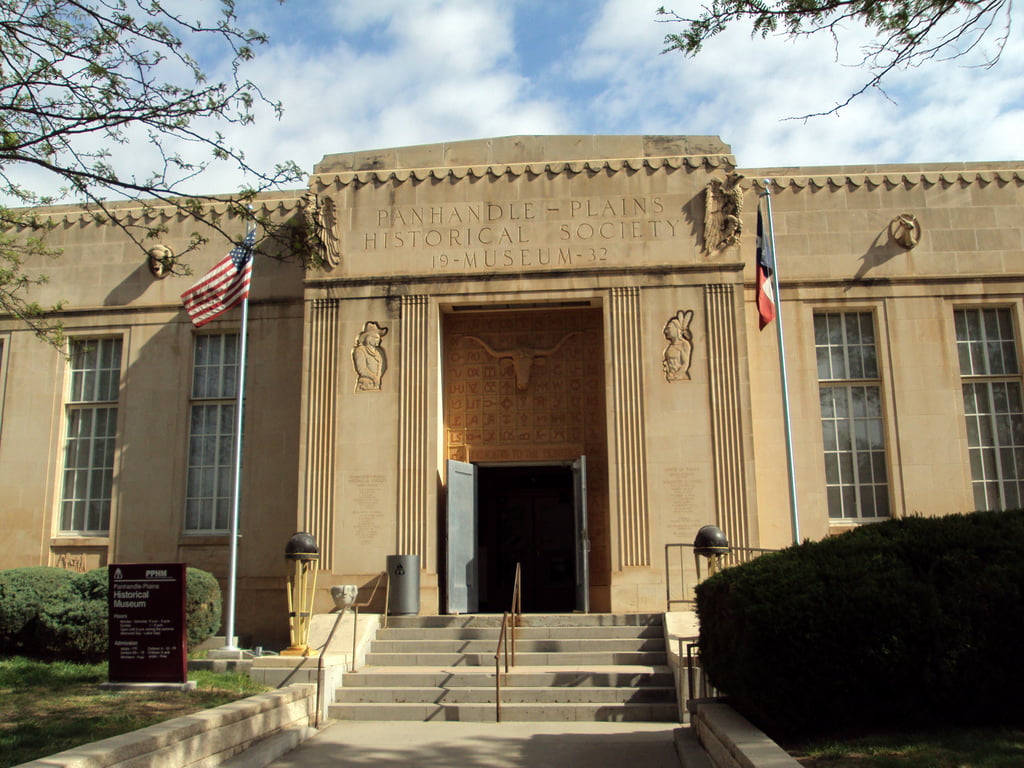
Panhandle Plains Historical Museum, Canyon, Texas
“What a Chain has Been Forged”
In the April 20, 1933, edition of the Canyon News, Clyde Warwick, newspaper owner, writes, “What a chain has been forged which will bind the hearts of the pioneers of West Texas to the Panhandle-Plains Historical Society, to the College and to Canyon! What an obligation it creates for the people of Canyon to see that the hospitality which was shown on the part of our citizenship on Friday will continue to be extended during the coming years! The pioneers of West Texas have builded a monument to themselves. Some of the stone, brick and mortar in that building represents real sacrifice on the part of these pioneers. Some of the money that was given to erect the museum came from those who could not afford to give. They gave it cheerfully that the history of this section might be preserved.”
ORGANIZING THE SOCIETY
The earliest Panhandle Plains Historical Society included students and professors of the teacher’s college and area community leaders, an idea traced back to 1921 from Dr. Hattie Anderson with the history department. Artifacts were kept on display in an office. By 1926 membership had grown to 99 members and 13 life members, as the artifact collection grew too.
“So great has been the response to the call for objects pertaining to the early history of this part of Texas that the museum has outgrown its present quarters.”
THE BUILDING COMMITTEE
A “Building Committee” was formed and members agreed to pledge $1000 each with a plan to find 100 men to donate $500. The “building fund campaign” was carried out by Judge Hoover from Canadian and Professor L. F. Sheffy who agreed to “go into the field” over one summer to tell people about the project and ask for their support.
Not only were they successful, but excitement spread “to erect a beautiful museum which shall be a depository for the relics of pioneer life.” Texas Governor Sterling signed legislation to award $25,000 in matching funds. PPHM became the first state and college affiliated entity of its kind. Considering that they achieved their monetary goal and constructed a building at the beginning of the Great Depression and the dust bowl is even more amazing.
“This committee seeks the assistance of the entire Panhandle in order that this may actually be a memorial to all pioneers of the Plains country.” Canyon News, Nov. 1928.
Growing up in the farming community of Dimmitt, my dad took me to the Canyon museum a few times when Pioneer Hall had rows and rows of artifacts displayed in glass cases. After graduating from WT, I volunteered as a docent for over 20 years. I spent every day of the week at PPHM during the months of April and May. We had a dedicated, knowledgeable group of volunteer guides who greeted 2,000 to 3,000 excited kids each spring. As I learned from more than one PPHM staff member, every item has a story and considering how large the collection is today, that is a lot of valuable narrative. From the staff to the volunteers, I can assure you that there was great pride in PPHM and the history it represents.
THE FIRST COLLECTION: Something to Be Proud Of
As the first curator of art, Mrs. Olive Bugbee was asked why the museums’ collection included items that are obviously not western related such as the Oriental art, European paintings and English dishes. She tells them that if ladies had not sat in wagons with their Dresden China in their laps…it would not be part of the museum. That beloved China is a part of the region’s heritage.
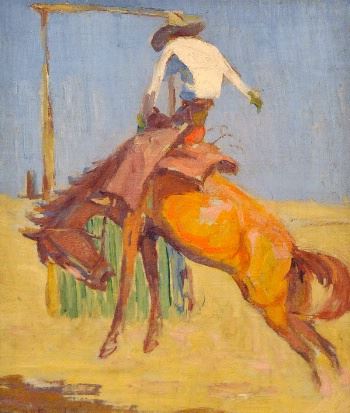
Notable and Earliest Acquisitions
- Works by Harold Bugbee donated by his wife, which is not only art but as she describes, “a picture essay of the times.” Olive Bugbee also donated her impressive jewelry collection.
- The stunning Tofano portrait of Cornelia Wadsworth Adair loaned by her grandson M. M. Ritchie, J. A. Ranch.
- Toys saved from the 1898 tornado that hit Mobeetie.
- Trustees of the Frank Reaugh estate chose PPHM as the place to receive 500 delicate pastels painted by the artist. His Will states, “It is my wish that these pictures be kept together if only for historical reasons. They recreate the spirit of the time. They show the sky unsullied by smoke, and the broad opalescent prairies not disfigured by wire fences or other sign of man.”
- A treasured set of works by naturalist Luther Burbank and 10 pictures of early Panhandle days from Charles Goodnight.
- One of the largest donors to the Society, Mrs. Olive Dixon, wife of plainsman and scout Billy Dixon, also served as second V.P. At a Society meeting she brought her husband’s Medal of Honor, and is recorded as saying that she was bringing these treasures because she was highly pleased with the way things she had contributed in the past had been taken care of.
- Mrs. Dixon wrote letters to early settlers asking them to loan their valuable collections to the Society, and she was charged with interviewing old-time settlers for a book.
- Comanche and Kiowa ethnological clothing (Curator of anthropology Billy Harrison (1971) considers it to be the largest collection in the world).
- Quannah Parker’s youngest wife Topay entrusted his war bonnet and lance in 1960 to the “coo-in-up” boy and PPHM. On the day she arrived in Canyon, about 150 kids from Pampa happened to be there and they all shook her hand. “Topay was taken all over the museum in her wheelchair.” Curator Boone McClure had cooked a steak for Topay at one of their previous visits. “Coo-in-up” is Comanche for “steak cooked over an open fire.” She could never remember Mr. McClure’s name, but she insisted that the deal include $30 every month so that she could buy “coo-in-up”.
- From the Goodnight Ranch, the main dining table, China, settee, and Mary Ann’s dinner bell.
- Guns were important to the collection: “rare in design and sure in hitting the mark.” One notable rifle was given by Kit Carson to Buffalo Bill, who in turn gave it to Charles Goodnight.
- The lifetime library of 2,500 volumes with rare books, correspondence and art owned by J. Evetts Haley. In addition he personally contributed over $30,000 to the building fund for the 1967 four-story addition. Haley was the first editor of the Panhandle-Plains Historical Review (1928).
- Personal records of DeWitt Lockman, prominent New York City portrait painter.
- Also of note, early souvenirs were hand-made by museum staff. Of the most popular items, kids loved the horseshoe nail rings.

A 1964 UNESCO travel guide listed PPHM as one of the
top 14 museums to see in the United States.
*** WE DID IT! ***
College President Dr. J. A. Hill is credited for inciting a fascination and love for the museum throughout the area. “If ever there were thousands of people who could truthfully say … we did it, it must be the members of the society that built the first museum ever erected on a state college campus in Texas.”
PPHM is not just a building occupying a corner lot now labeled a fire hazard and ear-marked for something else in the university’s long-range plan. It is so much more than a building. PPHM represents the people of a region who entrusted their most treasured possessions for safe keeping.

There are many, many more notable artifacts and events related to PPHM; too many for this former docent to post here. Everyone who I knew and worked with at PPHM held the utmost respect for what this building contains, and we did our darndest to keep that message alive. I hope that our story is not extinguished by those who hold the power yet have no roots here.
“Today we are making history. Today is a day of triumph in the great Panhandle of Texas, today we dedicate to posterity the acts and deeds of the great men and women who have made possible the many blessings we here and now enjoy. With a heart full of love and appreciation we have erected to their memory the most beautiful structure in this, the land of their deeds of heroism and unselfish devotion, and filled it with the personal evidence of the hardships, trails, and privation they endured and also the evidence of the well earned success which so justly crowns their unselfish efforts to upbuild this land of ours which they so dearly loved.” Judge Hoover at Pioneer Hall’s Dedication ceremony, 1933.
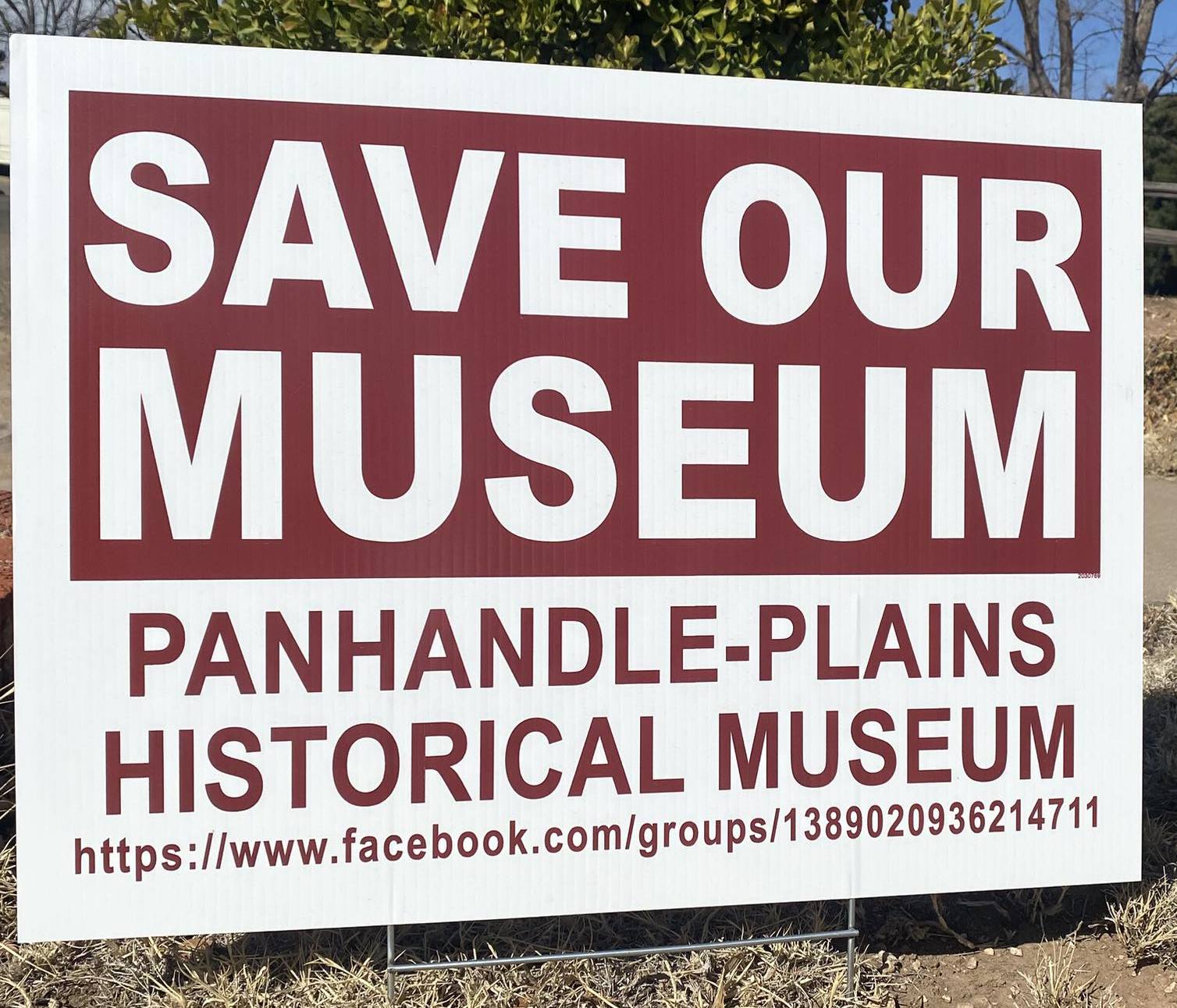
SAVE OUR MUSEUM on Facebook
A group of concerned citizens started a Facebook Group in December of 2025. Membership has grown to close to 10,000 in three months! You can pick up SAVE OUR MUSEUM signs at either of the Burrowing Owl Bookstore locations in Canyon or Amarillo. Follow the Facebook group “Save Our Panhandle Plains Historical Museum” and keep posting your memories of what PPHM means to you.
Ref: Various publications and Docent Training materials, “The Panhandle Plains History Society and Its Museum” by Dr. J.A. Hill, 1955.
Natalie Cline Bright is an author of books for kids and adults, content creator, people connector, and history nerd. For recipes from the old west chuck wagon days and Kansas Cowtown, her award winning history/cookbooks KEEP ‘EM FULL AND KEEP ‘EM ROLLIN’ and END OF THE TRAIL EATS are available wherever fine books are sold. Her most recent release is set in the Texas Hill Country, written with German author Manuela Schneider, A NEW FATHERLAND, is inspired by the true story of the Germans who risked everything to start over in the Texas wilderness and is available in both English and German markets. Click on the book tab above for more information about her books.
SUBSCRIBE NOW
Social Media


