
Peace Treaties and Broken Hope
The second historical fiction collaboration with coauthor Manuela Schneider will be coming soon from EK-2 Publishing. Apologies to our readers; the publishing delay is totally my fault.
A New Fatherland: Peace Treaties and Broken Hope is set in the Texas Hill Country after Texas wins the war for independence from Mexico. As far as Texas history goes, the state was a flurry of activity and violence during that time period and unfortunately, I had to go down every rabbit trail in my research. My head is still spinning. On the other side of the ocean, Manuela dove into the history of the Adelsverein, a group of noblemen who saw great potential in the wilderness of the Texas Hill Country.
Meet Josef Lehmann
The story centers around Josef Lehmann, a German nobleman sent by the Adelsverein to assist the commissioner general, Prince Carl of Solms-Braunfels. Josef’s character is inspired by German aristocrat Emil Kriewitz, who was not a prominent name of record (we had to dig deep to find him), but he played a significant role in the peace efforts with the Comanche. No spoilers yet.
Sophie Returns
Sophie Dankert is back by popular demand because so many of you have asked us about her, one of our main characters from A New Fatherland: German Freedom under the Texas Sky. Manuela’s instincts were spot on regarding how much this character resonated with readers. Sophie’s character was inspired by the heart wrenching true life of Mathilda Doebbler Gruen Wagner. At only nine years old, Mathilda’s father and stepmother sent her to work for a family in San Antonio. She had several children by their son and eventually returned to live not far from her father again. Her life was one of constant hard work. Her first hand account is out of print now, but it was published by a granddaughter in 1937 as I Think Back: Being the Memoirs of Grandma Gruen.
Podcast Interview
Manuela and I did a Podcast interview about our collaboration on LA Talk Radio with Rendezvous with a Writer hosted by Bobbi Jean and Jim Bell. We had a fun discussion.
Click Here to Join the Podcast: LA Talk Radio – YouTube

On To Texas, On To Texas!
“People who have never gone through it can’t realize how these people who started the little Texas towns and made them grow had to starve and do.”
Mathilda Wagner
For the second book, Manuela has done great work at taking us back to where it all began: Biebrich Palace on the Rhine near Mainz, Germany. Twenty-one nobleman and one noble-woman met to fund a Germany colony in Texas. In glowing terms, they offered a chance for prosperity and property ownership. Their primary motivation was purely for humanitarian aide of course, but mainly for commercial reasons. The German settlements would influence German industry and potentially increase German maritime commerce. A successful settlement in America could mean a new trade route for German products. The situation was dire in Europe, and these noblemen were young, educated and ambitious. They realized the lack of potential to increase their own personal wealth in their own fatherland. The Society for the Protection of the German Immigrant influenced a mass exodus from Central Europe with the destination being North America, and particularly the Republic of Texas.

Adelsverein: The Numbers
- The first Commissioner General of the Verein established the Port of Karlshafen (aka Indianola) on the Texas coast for Verein immigrants. It became a significant deep-water port during the Mexican War and for thirty years its army depot supplied the frontier forts until it was destroyed by a hurricane.
- Two agents of the society met with Republic President Sam Houston to purchase a league of land (4,428 acres), naming it Nassau Farm.
- The first ship load of Verein immigrants arrived in December 1844.
- New Braunfels and Fredericksburg were the first two settlements.
- Between October 1845 and April 1846, a total of 5,257 German immigrants were brought to Texas.
- By the end of 1847, the Adelsverein was bankrupt because the cost of such a venture had been miscalculate.
- By 1850 German colonizers made up 5 percent of the Texas population.
- In September 1853 all property and colonization agreements were assigned to the Adelsverein creditors.
- Even after the Adelsverein went bankrupt, German migration continued to Texas ports.
- Today, an estimated 3,000,000 people in Texas can trace their roots to German-Texan ancestry, and across the U.S. around 40 to 50 million Americans claim full or partial German lineage.
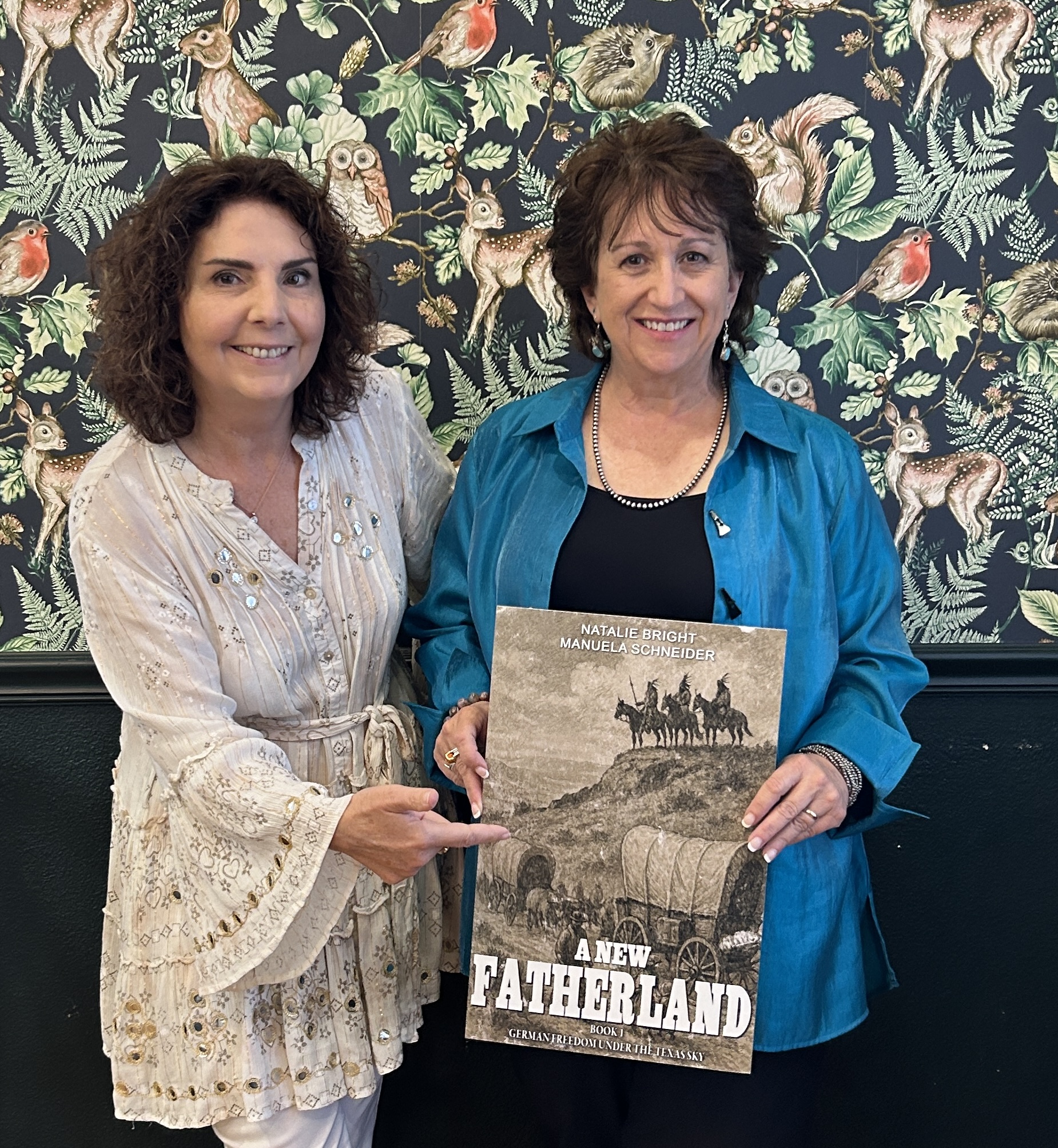
Natalie Bright is a blogger, author, speaker and content creator. Her article about the Windy Duece Wildfire recently won the 2025 Award from the Academy of Western Artists. Both of her history cookbooks have been recognized by the Will Rogers Medallion Awards with a first place gold medallion. Her kids books feature horses; historical western TROUBLE IN TEXAS series for middle grades, is a wild west adventure for the entire family, and the RESCUE ANIMAL series features true stories about rescue horses. She is currently working on a second book about the German colonizers who settled Texas with German coauthor Manuela Schneider. A NEW FATHERLAND series will be published in both English and German.
SUBSCRIBE NOW
Social Media


